
Educational guide only. Not legal, admissions, or counseling advice. Confirm deadlines and rules with each college and your school counselor.
If your personal essay reads like a second activities list, readers skim. Put them in one real moment instead.
Why I wrote this
I see the same pattern every application season. A student pastes awards, club titles, and travel into the personal essay, then wonders why the draft feels flat. The Activities section already holds that resume. The essay has a different job.
This piece is for high schoolers writing Common App or similar personal essays. It is a practical writing guide. It is not a promise about admissions. It is not counseling or legal advice. Rules and prompts change by school and by year. Always check the college and talk with your counselor.
Have you ever finished a draft and thought, "That sounds like a brochure"? You're not alone. Watch the short version first, then use the checklist when you draft.
What one real moment actually means
Pick a scene you can place in time and place. A Friday night shift. A practice that went wrong. A quiet talk after a fight. An hour when you chose the harder option and nobody clapped.
Readers don't need your full biography. They need evidence of how you notice the world and how you respond when something is at stake. A strong moment is small enough to see, and large enough to show change.
If you can't name the room, the weather, or what you were holding, the scene is probably still too abstract. Add those details. Then cut anything that doesn't belong in that room.
I tell students to ask one blunt question: if I filmed this scene for thirty seconds, would a stranger know what was at risk? If the answer is no, the draft is still summarizing life instead of living inside a moment.
What to cut even when it feels impressive
Trophy lists belong in Activities. GPA and class rank belong in the application forms. The essay isn't a second dump of the same facts.
- Awards and titles that already appear elsewhere.
- Travel that is only scenery, with no choice or change attached.
- Quotes from famous people that do your thinking for you.
- A moral taped on at the end ("and that is why I want to help humanity").
- A life summary that starts at age five and never lands in one scene.
Cutting isn't throwing away your story. It's choosing the frame. Photographers crop for a reason. Writers do too. When I help a student revise, we usually delete the opening paragraph of awards first. The draft gets louder, not quieter.
Keep a scrap file if that helps. Paste the cut lines there so you don't feel like you're deleting your life. You're not. You're moving facts back to the sections that already ask for them.
A structure that still feels human
You don't need a movie ending. You need a clear before, a choice, and an after. Four moves usually hold:
- Open in the moment. One concrete detail in the first two sentences. Sound, light, a tool in your hand, a sentence someone said.
- Show the friction. What was hard, unclear, or unfair. Skip melodrama. Name the pressure in plain words.
- Show your move. What you did, asked, built, stopped, or admitted. Action beats adjectives.
- Show the after. A small, honest change in how you act now. Not a TED Talk. A habit you kept.
If step four sounds like a campaign slogan, rewrite it until a friend would believe you said it out loud. Would your sibling roll their eyes at that last line? If yes, rewrite it again.
Some students worry that one scene can't carry a whole essay. It can, if the after is real. The scene is the proof. The after is the meaning. Without both, you either have a diary entry or a speech.

Voice check before you submit
Voice isn't slang for its own sake. Voice is whether the sentences sound like you under pressure, not like a brochure.
- Read the draft out loud. If you stumble, shorten the sentence.
- Ask: could a stranger steal this story and it would still fit them? If yes, add specifics only you would know.
- Ask a trusted adult for clarity, not for a rewrite in their voice.
- Check the prompt again. Answer the question the college asked, not the essay you wish they asked.
Parents and tutors can spot holes. They shouldn't replace your sentences with theirs. Admissions readers notice when the voice suddenly sounds thirty-five. I've heard drafts where the middle paragraphs were clearly written by a parent who meant well. The fix is kindness plus boundaries: "Tell me where you're confused. Don't rewrite my verbs."
Contractions are fine. Short sentences are fine. A quiet joke can work if it's true to you. Forced slang doesn't.
A one-page practice you can do this week
Set a timer for twenty-five minutes. Write one page about a single scene. Ban resume lines for that page. No club titles. No GPA. No "ever since I was young."
When the timer ends, underline every sentence that could happen only to you. Keep those. Cut or rewrite the rest. That page is your seed. Expand it into the full essay length the application allows. Then cut again.
If you have two strong scenes, write both seeds. Pick the one that shows change more clearly. Save the other for a supplemental essay if a college asks for another story.
Don't wait for the perfect topic meeting. Start with the scene you can still smell. The cafeteria tray. The bus stop. The lab bench. The kitchen after a hard call. Specificity is a kindness to the reader.
Common traps I see in early drafts
The highlight reel. Five wins in five paragraphs. None of them breathe. Fix: one scene, full.
The borrowed thesis. The essay argues a big idea ("leadership is service") without a lived moment. Fix: start in the room, end with the change.
The apology tour. The draft spends half its words explaining why the writer isn't impressive enough. Fix: stop arguing worth. Show what you did when it counted.
The fake twist. A last-line surprise that the rest of the draft never earned. Fix: plant the stakes earlier so the after feels inevitable, not clever.
The AI polish pass. Tools can catch typos. They shouldn't invent your memories. If a tool suggests a "powerful" ending you wouldn't say, delete it. Your job is truth with craft, not a smoother fake.
How this fits the rest of the application
Think of the application as a set of rooms. Transcripts and scores are one room. Activities are another. Recommendations are a third. The personal essay is the room where a reader meets how you notice and choose.
That means the essay shouldn't try to win every room at once. Let Activities carry leadership titles. Let the essay carry the moment those titles can't explain. When the pieces stop fighting each other, the whole file gets clearer.
If a supplemental asks "Why us?", don't paste your personal statement. Answer that prompt with specific research. Keep this one-moment craft for the personal essay lane.
What this guide is not
This isn't a ranking of colleges. It isn't a template that guarantees admission. It isn't legal advice, and it isn't a substitute for your counselor, teachers, or each college's written instructions.
Deadlines, word limits, and prompts change. Some schools want a personal statement. Some want short answers. Some want both. Read the portal. Confirm with a counselor when you're unsure. If a school bans AI assistance for drafting, follow that rule. If a school allows tools for grammar only, stay inside that line.
Further reading and next steps
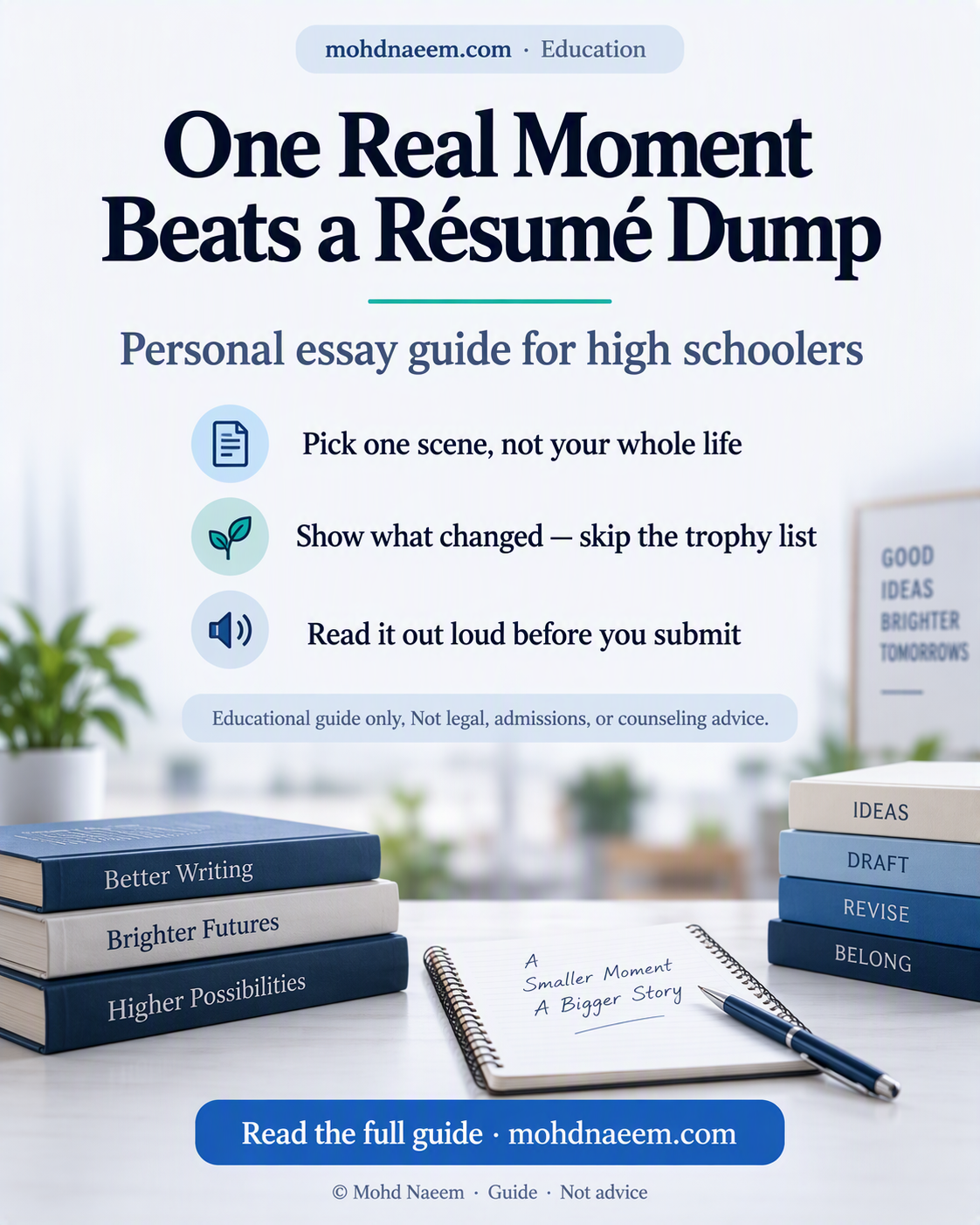
- Re-watch the short: One Real Moment Beats a Resume Dump.
- Save the flyer above for your study wall or shared family chat.
- Write the one-page seed this week. Bring it to a counselor or teacher for clarity notes only.
- When the draft feels stuck, cut another trophy line and add one sensory detail from the room.
- Ask yourself once more: would a thirty-second clip of this scene show the risk? If not, dig deeper into the room.
Checklist
- One scene named with time and place.
- Friction shown without melodrama.
- Your move stated in concrete verbs.
- After shown as a small real change.
- Trophy list removed from the essay body.
- Draft read out loud at least once.
- Prompt and word limit checked against the portal.
- Adult review asked for clarity, not a ghostwrite.
- Disclaimer remembered: guide only, not admissions advice.
Image credits: Flyer art © mohdnaeem.com Education. Desk notebook photo: Unsplash 1455390582262-044cdead277a. Laptop and notes photo: Unsplash 1434030216411-0b793f4b4173.